When it comes to Medicare, it's important to understand that Medicare Part A and Part B don't cover everything. They leave gaps, such as copayments, coinsurance, and deductibles, which you may have to pay out of your own pocket.
Medicare supplements were built to supplement the benefits that Medicare offers and fill in the gaps for the missing pieces.
What Medigap Covers:
the out-of-pocket costs
copays
coinsurance
deductibles
What Medigap Does Not Cover:
Dental
Vision
Hearing
prescription drugs
Unless Medicare itself would cover it as a medical procedure.
For example, if you need surgery for cataracts or glaucoma, Medicare covers the surgery, and your Medigap plan helps cover your share of that cost too.
What is a Medicare Supplement / Medigap?
Medicare Supplement Insurance, also referred to as a Medigap insurance policy, is a form of private health insurance that works alongside Original Medicare Parts A and B. This coverage helps pay for out-of-pocket costs not covered under Original Medicare, including copayments, coinsurance, and deductibles.
Medicare Supplement insurance policies are federally regulated insurance policies sold by private insurance companies. Medicare Supplement Insurance policies work like Original Medicare in that there is no network of doctors that you are required to see. Typically, any doctor that accepts Medicare will also accept a Medicare Supplement.
Benefits
Eligibility
How It Works
No provider networks. You can see any doctor who accepts Medicare. There's no "in-network" or "out-of-network" to worry about.
Predictable costs. You'll know roughly what your monthly premium and any remaining costs will be, which makes budgeting for healthcare easier.
Freedom to choose. You pick your own doctors and specialists without needing referrals.
You must have both Medicare Part A and Medicare Part B to qualify for a Medicare Supplement policy.
Maryland Gives You Two Windows Each Year
Most states only give you one guaranteed window when you first turn 65. Maryland is different. Maryland law gives residents a second guaranteed window every single year, called the Birthday Rule.
Window
When It Happens
How Long
What You Can Do
1. Federal Open Enrollment
Once in your life, starts the month you turn 65 and have Part B
6 months
Buy any Medigap plan, from any company, at standard rates
2. Maryland Birthday Rule
Every year, starts on your birthday
30 days
Switch to a plan with equal or lesser benefits, same or different company
3. Guaranteed Issue Period
When you lose certain health coverage, such as employer-sponsored insurance, or experience another qualifying event that gives you Guaranteed Issue Rights.
63 days from the date your coverage ends.
Apply for a Medicare Supplement (Medigap) plan.
Buy a plan without medical underwriting.
Cannot be denied coverage because of your health if you qualify for Guaranteed Issue Rights.
Maryland's Birthday Rule, Explained Simply
Every year, on your birthday, a new 30-day window opens. During that window, you can switch your Medigap policy to a plan with equal or lesser benefits without answering any health questions and without being turned down.
Question
Answer
When does it start?
Your birthday, every year
How long does it last?
At least 30 days (some companies choose to allow longer)
Do I have to stay with my current company?
No, you can switch to a different insurance carrier
Can I upgrade to more coverage?
No, you can only move to a plan with equal or lesser benefits than what you have now
Will my company warn me?
Yes, your carrier must mail you a notice ahead of your birthday reminding you of this right
Important tip: Never cancel your current Medigap policy until your new policy has been officially approved and issued in writing. Cancelling too early could leave you with a coverage gap.
Household Discounts
Some companies have discounts for living with others. The discount is different with each carrier. Some offer discounts for just living with somebody in your household that is over 60 years old, while other carriers require both people to have a policy through their company. Please ask one of our agents to explain these potential discounts.
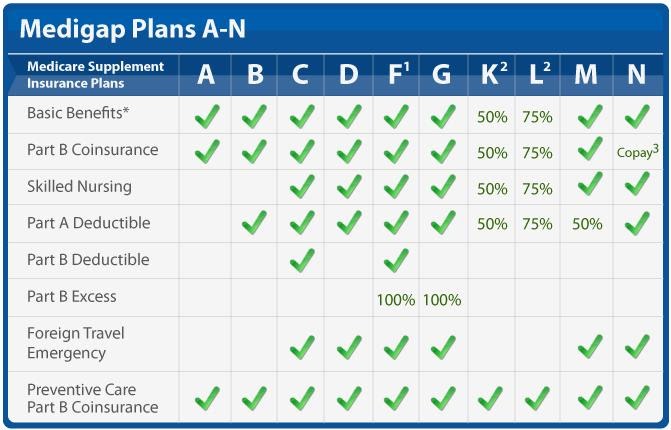
Below is a chart of Medicare supplement plans offered. It shows all of the different Medicare supplement plans available. The most popular plans insurance carriers typically sell are plans F, G, and N.
Medicare Supplement Insurance, also called Medigap, is private insurance that works alongside Original Medicare Parts A and B to help pay certain out-of-pocket costs such as copayments, coinsurance, and deductibles.
Does Medigap include prescription drug coverage?
No. Medicare Supplement plans generally do not include prescription drug coverage. Most people who want prescription drug coverage need to enroll in a separate Medicare Part D plan.
Can I see any doctor with a Medicare Supplement?
Generally, yes. Medicare Supplement plans do not usually have provider networks. Typically, any doctor that accepts Medicare will also accept a Medicare Supplement policy.
When is the best time to apply for Medigap?
The best time is usually during your Medicare Supplement Open Enrollment Period, which begins the month you are enrolled in Medicare Parts A and B and lasts for six months. During this time, insurance companies must generally accept you regardless of health condition.
What is Guaranteed Issue?
A Guaranteed Issue period is a time when an insurance company must accept a Medicare-qualified individual without medical underwriting. This can happen in certain situations, such as losing employer group health coverage.
Are Medigap benefits the same across carriers?
Yes. Medicare Supplement plans are federally regulated, so the same lettered plan provides the same benefits from one carrier to another. The main differences are the insurance company, price, and possible discounts.
Are Plans C and F still available?
Plans C and F are not available to people who became newly eligible for Medicare on or after January 1, 2020. People who already had these plans may be able to keep them.
What should I compare when choosing a Medigap plan?
You should compare the carrier, premium, pricing history, household discounts, plan benefits, and whether you also need separate dental, vision, hearing, or prescription drug coverage.